Friday, June 08, 2012

Liberal (education) Singapore

Yale University announced a while back that it is creating a liberal arts college in Singapore that will bear the Yale name. It seemed like a novel thing, providing a spark for humanities and education in Asia more broadly, where many national education systems emphasize test-taking and rote memorization. I was generally supportive, as I am part of a team at Stanford working on liberal education issues in Asia.

However, there has been serious dissent in recent months among Yale faculty members, who are concerned about partnering with a Singaporean government that restricts freedom of speech and press, stymies full political participation, and has some pretty draconian social laws that might not be in accord with American sensibilities.

I am weighing in now because we are holding our own liberal education program here at Stanford (Humanities Education and Leadership or HEAL) with many students from China attending, and I am struck, once again, by the moment.

Singapore Partnership Creates Dissension at Yale
http://www.nytimes.com/2012/04/05/education/singapore-partnership-creates-dissension-at-yale.html


Is Yale a Reliable Partner for the National University of Singapore?
http://globalhighered.wordpress.com/2012/04/03/is-yale/

So I might be wading into a thicket ... but I want to say to Yale:

Dear Yale,

Even Stanford, which the New Yorker claims is Stanford Inc. (and proud of it!), still respects and cares for its mission of liberal education. While the idea of a liberal arts college in Singapore is exciting -- East Asia sorely needs this kind of new approach to education -- the qualms of students, alumni and faculty ought to be heard, and the issues thoroughly aired and debated.

For example, what protections have been built in for the students and faculty you are welcoming under the banner of Yale in Singapore? In a country where censorship, paternalism, and intimidation by the state on political grounds still persists, will free speech be upheld? Can people sing, say, study, scream, demand, decry, support, condemn, protest and celebrate the same things they would at Yale in New Haven? What protections for freedom of thought, freedom of conscience, freedom to love have you asked for and been guaranteed in this new venture? Yes, I understand there's a prospectus that says some of the right words in this regard, but what is its scope and the strength of its promises?

It's one thing to be collaborative and to establish a new institutional culture based on mutuality. (One must still ask if that newly-formed culture remains true to the home school. That was one concern I had about Stanford in New York, and why many students were not unhappy when the plan was shelved). But when a foreign state offers to pay for everything to "import" Yale? In this case, you are in a position of power; you are not the supplicant. Use your leverage for good!

Yale is not just a brand name, and it is not a vocational school. It is an institution of higher learning. Aside from competence in the subjects, you have a greater mission to teach ethics, inculcate values, and contribute to the broadening of minds. Building a culture of open inquiry, respect for truth, and caring for others -- that is your mission. Please don't forget it.

Sincerely,
Kevin

I actually love Singapore and considered moving there after graduation. I'm still planning to go some day. However, I want this issue to be discussed and considered, not just rammed through over the objections of thinking, caring people -- our brothers, sisters and teachers at Yale, and perhaps also the scholars and watchers of East Asia and the American academic community at large.

The ironic thing is that I don't necessarily disagree with -- and frankly, am fascinated by -- many of the Singaporean government's policies. As a democrat, I take issue with muzzling of the press and the difficulties imposed on the democratic opposition. But many programs in housing and community development are innovative, effective and even sagacious, and could provide models we can learn from and apply in other contexts.

I was excited about the idea of Yale-NUS at first, but now I also want Yale faculty and students who have concerns to be heard.

I'm not sure if the university administration really has closed the case. But please read this editorial from our brethren at Yale. The intelligence and maturity with which they write makes me so proud.

Remaining Yale in Singapore
http://www.yaledailynews.com/news/2012/mar/30/when-yale-nus-opens-yale-must-throw-its-weight/

Thursday, May 10, 2012

Buddha Bathing Ceremony on Saturday

Tzu Chi Foundation - Northwest Region
Buddha Bathing Ceremony
2:00 pm - 6:00 pm
Orchard School, 921 Fox Lane, San Jose, CA 95131


Other West Coast ceremonies:


05/12/12
Portland Service Center
9:30 am - 11:00 pm
Conestoga Middle School
12250 SW Conestoga Dr, Beaverton, Oregon 97008


05/13/12
San Francisco Branch
10:00am - 4:00pm
Japantown Peace Plaza
Buchanan St. and Post St., San Francisco, CA 94115          

05/13/12
Oakland Service Center
10:00am - 3:00pm
Oakland 富興中心 (Pacific Renaissance Plaza)
388 9th Street, Oakland CA 94607

05/13/12
Stockton Office
2:00pm - 4:00pm
Stockton Office
1212 W Robinhood Dr.,  # 4F, Stockton, CA 95207

05/13/12
Seattle Branch
10:00am - 2:00 pm
亞洲資源中心 (Asian Resource Center )
1025 South King Street, Seattle, WA 98104

05/20/12
Seattle Branch
2:00 pm - 4:00 pm
Tacoma Community Center
1314 South L Street, Tacoma, WA 98405

The Tzu Chi Chinese school in Cupertino will also have a Buddha bathing ceremony on 5/19 at Lynbrook High School at 10:00 am.

Thursday, April 12, 2012

Big Dance 2012

Logo for the upcoming Big Dance at Stanford:

Thursday, March 15, 2012

Not as Funny

Now that Bo Xilai has been removed as Party Secretary of Chongqing, some bozo has meme-ified it and written a Goldman Sachs-style resignation letter from his perspective.

Unfortunately, the analogy in the meme is broken. It's not really appropriate to point to the "Cultural Revolution" as the "golden old days" in this parody. You could argue that the Party has lost its original ideals since 1949, but virtually no one (in China at least) wants to return to the horror and chaos of Mao's campaigns in the 1960s.

The Goldman Sachs piece argues for principled action and privileging clients above one's own short-term profits. That culture was something actually in place. It was successful and could rightfully be celebrated. While the Cultural Revolution warped ideals in a millenarian fashion, it was not just and it was not benign. No one in their right mind would laud it today.

Maybe I shouldn't take this "meme" so seriously, as it's just for entertainment, but it really irks me. The critiques of the Party are certainly valid -- but the supposed “solution” of bringing back the Cultural Revolution is far worse. That's obviously not a fix, and the author knows it -- yet persists in using it as if parodic tool. Not only does the meme's author fail to suggest a real salve to China's problems, he makes light of an episode of immense human suffering. Overall it's just ... inaccurate. If you're going to make a meme, at least construct it properly.

The problems in China are real and immense, and there might be real dissenters in the Party. This irresponsible joking does them a disservice. You are devaluing complaints against the CCP and the abandonment of its purported founding ideals by associating contemporary opposition with insane calls for total Cultural Revolution. It simultaneously twists the Goldman letter into a demand for rigid and violent ideological purity, when it's actually a call for ethics and balance in corporate conduct.

This meme plays straight into the Party's narrative that if we don't control everyone and restrain the masses, then the Cultural Revolution will be repeated: Chaos and disorder will reign, and more people will die. Oh, plus you won't get rich anymore. Everything China has gained since Reform and Opening will be lost!

A real Goldman Sachs-type letter out of the Communist Party could have the same shocking effect and cause some national soul-searching. (Or is that too hopeful? Maybe everyone who joins the party is a cynic these days. But then at very least it could lay bare the utter hypocrisy permeating every trembling, ecstatic breath extolling China's wonderful socialist model.)

Instead of providing a guerrilla act of dissent, this meme trivializes China and its history, just for a cheap laugh. Classy, just classy.

Wednesday, March 14, 2012

If you want to work in Finance

The blogosphere is abuzz about the Goldman Sachs employee who resigned after watching the company's culture descend into sheer profiteering and becoming "toxic and destructive" -- and who penned an op-ed in The New York Times about this decision.

Some choice quotes:

The firm has veered so far from the place I joined right out of college that I can no longer in good conscience say that I identify with what it stands for... I truly believe that this decline in the firm’s moral fiber represents the single most serious threat to its long-run survival...

I have always taken a lot of pride in advising my clients to do what I believe is right for them, even if it means less money for the firm. This view is becoming increasingly unpopular at Goldman Sachs. Another sign that it was time to leave. How did we get here? The firm changed the way it thought about leadership. Leadership used to be about ideas, setting an example and doing the right thing. Today, if you make enough money for the firm (and are not currently an ax murderer) you will be promoted into a position of influence...

Today, many of these leaders display a Goldman Sachs culture quotient of exactly zero percent. I attend derivatives sales meetings where not one single minute is spent asking questions about how we can help clients. It’s purely about how we can make the most possible money off of them... It makes me ill how callously people talk about ripping their clients off. Over the last 12 months I have seen five different managing directors refer to their own clients as “muppets,” sometimes over internal e-mail.

I hope this can be a wake-up call to the board of directors. Make the client the focal point of your business again. Without clients you will not make money. In fact, you will not exist. Weed out the morally bankrupt people, no matter how much money they make for the firm. And get the culture right again, so people want to work here for the right reasons. People who care only about making money will not sustain this firm — or the trust of its clients — for very much longer.

This article should be translated into Chinese and disseminated as widely as possible. (I've already posted a link on Renren). It's not just a Goldman Sachs problem, though that company had certainly crystallized the issue. It's a whole-culture problem if screwing others in the pursuit of wealth is seen as the loftiest and worthiest goal, and perfectly justified.

If Goldman really isn't the way it's portrayed, and its employees are all upright corporate citizens, then the company's leaders should laud and celebrate every principle raised in this piece. The only thing they could claim is that they agree completely with all his ideas, but the op-ed is inaccurate because GS already lives up to those ideals.

And well, if the company doesn't actual reflect those principles, and the executives end up covering themselves by attacking this guy -- then at least all those Goldman employees will be jolted into a moment of clarity. They will have to take a hard look in the mirror and ask what kind of company they work for. (Also see reaction from former employees.)

It's a thorny problem, and I'm actually rather glad it got tossed in Goldman Sachs' lap. Either they'll be forced to live up to these standards and affirm (or reaffirm) internally what believe in and let employees judge for themselves -- or they can just admit that they don't believe in such principles and simply put profits first, in which case smart employees and savvy clients will want to GTF out of there.

UPDATE  (3-15-2012)
My friend Patrick, who previously spent time at J.P. Morgan and also observes China, posted this:

"China in itself is like Goldman Sachs. The business culture there is as corrupt, if not more so, than Goldman's. The only thing that's good about it is that China is openly corrupt while Goldman hides their shitty deals as 'Abacus CDOs.'" LOL.

Monday, March 12, 2012

Motion and Rest

These "cinemagraphs" are pretty cool -- a different format for images, perhaps a new medium for visual communication. (See this description in The Atlantic Monthly.)


However, from the examples I've seen, many of these works are a bit too focused on the actual animation without paying attention to rhythm and rest. I like the hair blowing in the wind in the GIF above, but an actual breeze wouldn't continuously go back and forth, back and forth. The model's hair should come to rest and stay there a bit before another puff of wind sets it into motion again. That would feel more natural.

If you go to the Cinemagraphs website, you'll see what I mean, with the set of images on the front page. They feel very mechanical -- they don't really seem life-like, not only because of the regularity of the motion, but because that motion is nearly continuous. Pauses and "drift time" would make these images more aesthetically pleasing, and set the viewer more at ease.

It's possible that for some effects, you might want rapid flashing, alternating colors over and over -- but not everything is Vegas.

Friday, February 03, 2012

Lantern Festival coming to Stanford

Come celebrate the Lantern Festival, which marks the end of the Lunar New Year holidays. Enjoy booths serving almond jelly, boba and mochi, under a sky lit by paper lanterns and stars.


5-8 PM @ Bechtel International Center

Featuring performances by the acclaimed magician Andrew Evans
and the Stanford Wushu Team.

To attend, you will need to RSVP AT OUR FACEBOOK PAGE
Brought to you by AAGSA, AASA, ACSSS,
CWCS, KSA, Lambda Phi Epsilon, TCS,
Tzu Chi, SUN, and UCAA

** REMEMBER TO BRING YOUR OWN REUSABLE
BOWL + FORK + MUG/BOTTLE **


Generously supported by the Billie Achilles Fund, Bechtel International Center, GSC, and the ASSU

Tuesday, January 24, 2012

Society

Important statement about (modern) American society from David Brooks in his latest column.

Social support and community building are critical to a society's development. Given the dissolution of traditional norms and structures during the process of modernization (see "anomie"), we need to find new forms of association that provide support and moral guidance, and allow children to grow up in stable, healthy conditions with access to education.

Okay, I probably sound kind of conservative and/or Confucian and/or Singaporean, but I'm recognizing more and more that it's not just personal freedoms or market freedoms that matter in being able to live a good life. The form of community in which we live, and the education we receive when we are growing up (both inside and outside the classroom) also play a crucial role.

As David Brooks points out, the two political parties are focusing on material gains instead of looking at key social questions afflicting America. It's not the hot button social issues we should be looking at (abortion, marriage equality, stem cell research), but more basic concepts like family integrity and humanistic values (like not being greedy and materialistic; caring for others, not just oneself). Aside from the individual, there is the family as the basic building block of society, as well as the larger neighborhood/community/networks of care setting norms and expectations and helping to maintain them.

The "materialistic ethos" of both political parties means they're focusing too exclusively on economic questions without understanding the social context in which they sit. For example, Brooks finds that the Democrats now emphasize "reducing inequality instead of expanding opportunity. Its policy prescriptions begin (and sometimes end) with raising taxes on the rich. This makes you feel better if you detest all the greed-heads who went into finance. [Admittedly there's something satisfying about this.] It does nothing to address those social factors, like family breakdown, that help explain why American skills have not kept up with technological change. If President Obama is really serious about restoring American economic dynamism, he needs an aggressive two-pronged approach: More economic freedom combined with more social structure; more competition combined with more support."

Without looking at human beings as part of the equation, and in particular, considering human beings as moral, communal and spiritual beings with beliefs and ideals and worldviews -- then the economics-only approach, the technical-engineering-only approach, the "install the hand pumps-but-ignore-the-programmatic-side" approach, will not be sufficient to right our society. This doesn't mean we can't use numerical metrics to look at social support and evaluate progress. But without countenancing norms and ideas, we are ignoring something fundamental in society.

Friday, January 20, 2012

Choreography

Don't piss off the choreographer by being late -- otherwise, he might turn into Dakota Stanley!

Thursday, January 19, 2012

Corelliana

Michael Tippett's "Fantasia Concertante on a Theme of Corelli"

Fantasia Concertante on a Theme of Corelli by Royal Philharmonic Orchestra on Grooveshark

Monday, January 16, 2012

Hello & Goodbye to Huntsman.

Huntsman Says He's Quitting G.O.P. Race
thecaucus.blogs.nytimes.com
Jon M. Huntsman Jr. informed his advisers on Sunday that he intends to drop out of the Republican presidential race, ending his candidacy a week before he had hoped to revive his campaign in the South Carolina primary.

Good run, Gov. Huntsman. I look forward to seeing you four years from now. From The New York Times:
Huntsman "formally announced his candidacy in June, in the shadow of the Statue of Liberty, calling for a more civil kind of presidential campaign and promising a better future than the one that Mr. Obama would provide. 'He and I have a difference of opinion on how to help a country we both love,' Mr. Huntsman said of Mr. Obama. 'But the question each of us wants the voters to answer is who will be the better president, not who’s the better American.' 
But the campaign of ‘civility, humanity and respect’ that Mr. Huntsman promised quickly faded into the background as his Republican rivals seized the attention — and the support — of a party faithful that seemed more interested in red-meat politics.“
Is this really the party the GOP aspires to be? One that revels in hatred and division, blame and vilification, rather than representing an open-minded and deliberate, but principled, political alliance? I mourn the day that an intelligent, humane and successful leader such as Governor Huntsman is driven from this party -- or at least for all intents and purposes, barred from victory. It signals the disappearance of justice, decency, civility and truth as watchwords of the Republicans, and highlights how ideology, conformity, tribalism and fear have gained ascendancy. Patriotism has been stamped out by nationalism.

This was once the Party of Lincoln. Where is the courage to do what is unpopular but right? Where is the leadership that unites a people, that venerates humanity, that speaks truth to power? Where is the voice for the voiceless, protecting the downtrodden and the minority citizenry? Where is the beacon that seeks reform? That busts the trusts, secures the safety of our comestibles, and offers a Square Deal to every American? The Republicans created the National Parks, founded the Environmental Protection Agency, signed into being the Clean Air and Water Act.

The "grand" vision of the GOP has been lost in the squalor of American politics and small-minded partisan fighting. It has been lost to the plutocratic clutches of corporate donors. It has been ceded to self-absorbed and self-interested wealth. It no longer seeks to educate its citizens to be more broad-minded, noble and loving, but to barricade themselves against science and reason, while xenophobically attacking the new as alien.

I am looking for Republicans, but I see only the mob carrying torches, with demagogues in their midst whispering poison among them. Moral leadership to open the hearts and minds of men has fallen into disfavor. Polls and consultancies do not inform but control. Inspiration has fled, and incitement has moved into its stead. These men do not seek to lead the crowd to protect their rights and the rights of their brethren. They beguile and play rhetorical tricks, stoking the worst of emotions and striking the most frightening of notes. They levy threats, sell destructive tales, rend humanity.

It is the road to disenfranchisement, the atomization of men. It is the splintering of the solidarity in democracy and mutual responsibility that once helped strengthen and guide our Republic. It is an abdication of the worst kind, for it leaves our country vulnerable -- destitute of reason, bereft of a universal sense of ethics.


The Republic is breaking, and we need women and men who care enough to mend it. They will heal society by building communities -- not by tearing them down -- and halt the blasting apart of the nation that has been built over generations by so many dedicated, enterprising, creative and caring hands. Such were the hands that belonged to Americans (plural) -- federalist, democratic, republican, liberal, constitutional Americans. They created a new kind of society that represents a unique and courageous experiment for mankind. May it live for many more lifetimes.

Tuesday, January 03, 2012

Whose assault?

www.nytimes.com
"In an essay published this week in a Communist Party policy magazine, President Hu Jintao said the West is trying to dominate China by spreading its culture and ideology."


Nah, the West isn't trying to spread its culture. You just destroyed your own (see: Cultural Revolution 1966-1976) and left a massive vacuum. Are you concerned that materialistic folks are now buying Western pop culture as the thing?

"President Hu Jintao has said that China must strengthen its cultural production to defend against the West’s assault on the country’s culture and ideology" FYI strengthening culture is probably not best served by increasing Communist propaganda. How about supporting traditional cultural enterprises?

"international hostile forces are intensifying the strategic plot of westernizing and dividing China." Well, they're not the ones who demolish ancient temples and raze traditional architecture, replace them with shopping malls, and lay down ugly tarmac and 8-lane highways in the middle of cities where generations of families once lived. Greedy developers and complicit CCP officials are really the ones responsible for confusing "modernization" and "Westernization" -- anyone else is just following their lead. (Sometimes I wonder if "modernization" is even the goal, or if infrastructure is just a byproduct of self-enrichment). The authorities are the ones who adopt sh-t city planning that's good for cars and not people, just like -- oh wait for it -- the Americans did in the mid-20th century. So watch where you're pointing your fingers.

By the way, people from the West are also not the ones who forced the country to adopt Soviet-style (i.e. alien) economic planning (which utterly failed, by the way), or who divided the country into "black" and "red" classes and pitted them against each other.

It's the people in power and the rich who are taking the worst aspects of "Western" culture, such as unbridled capitalistic greed -- laughing all the way to the bank as they douse the country with it -- while ignoring important features of Western life such as freedom of speech, checks and balances, and the consent of the governed and public participation.

Let's close on this note: "In his essay, Mr. Hu did not address the widespread assertion by Chinese artists and intellectuals that state censorship is what prevents artists and their works from reaching their full potential. Last week, Han Han, a novelist and China’s most popular blogger, discussed the issue in an online essay called 'On Freedom.' 'The restriction on cultural activities makes it impossible for China to influence literature and cinema on a global basis or for us culturati to raise our heads up proud,' Han Han wrote."

Ironic that for Chinese culture to flourish, the state should take up some "Western" features. Oh wait ... maybe that means that those features are less "Western" and more global than you want to admit. Just some food for thought.

Thursday, December 22, 2011

A deep and thorough cleansing

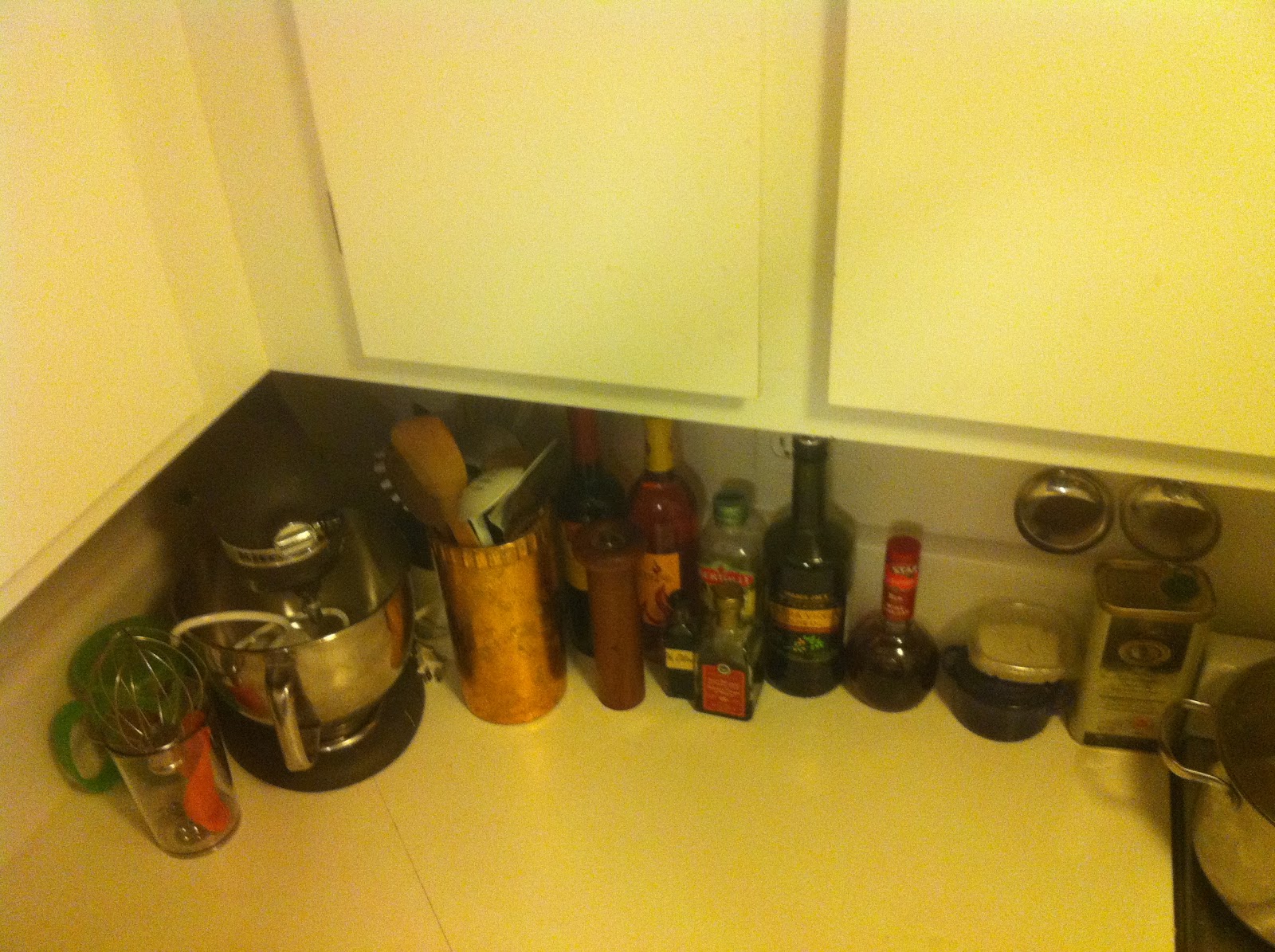
Be proud of us! Eric and I cleaned the apartment. Too bad we didn't take before/after photos, or document things in process -- we were too busy handling the mess and making new discoveries. =P

Here are the results:

1. Sorted the dish cabinet, with mugs, glasses, plates and bowls all in their proper spheres. The dishes enqueued in the sink had their cases resolved.


2. Cleaned the top of the refrigerator, which involved removing a rotting bag of onions and scrubbing away the slime. Unfortunately, due to the lack of paper towels or rags, I had to substitute in toilet paper. Not pleasant. However, it is now a neat and tidy pasta station!


3. The counter top hadn't been wiped in ages, probably because of the accumulation of pots, pans and other detritus over the past couple months. We washed it down thoroughly with soap and water, removing some very sticky patches.


4. The cabinet which had been haphazardly stuffed with jars and plastic bags has been resorted. Clockwise from the top left: (1) teas, teabags, and other hot drinks; (2) baking mixes and non-traditional flours; (3) vegetable, canola oil and spices used for stove-top cooking; (4) canned goods.


5. Stove area has largely been cleared. Pans are currently stored in the oven, due to limited counter and cabinet space.


6. Overall, the kitchen feels more open, providing a pleasant and inviting work space. Pots, pans and dishes are no longer stacked precariously on the remnants of earlier culinary expeditions. Users will now have full access to the range of tools, ingredients and prep surfaces, yielding a more efficient -- and more fulfilling -- cooking experience.


Good marketing speak, right? =D With any luck, the apartment will stay this way for a little while. There'll be a few week's reprieve, at least, since we are all heading out for winter break.


Happy Holidays!

Friday, December 16, 2011

Stanford is a University of California, too!

Stanford announced today that it is dropping out of the competition to build a new engineering campus in New York City. The Board of Trustees is meeting this week, and this is probably an outcome of one of those discussions. (The alumni association dutifully informed all alumni via e-mail early this morning, so I found out before The New York Times reported on it later in the day.)

So I'm not trying to sound heretical or anything ...

But I wonder what would happen if Stanford took all that money saved from not developing a $2 billion campus in New York, and instead forged stronger relations with the UCs, starting with a certain institution right across the Bay. In these challenging times, we ought to focus our efforts on rebuilding at home. There is a lot of room for collaboration with our friends and erstwhile rivals at Berkeley, and both our institutions -- as well as the State of California -- would be the stronger for it.

Last Friday at the "Occupy the Future" rally, former Stanford president Donald Kennedy (also editor-in-chief of Science; you can be a great scientist and have a social conscience =D) called on the Stanford community to be concerned with the fate of our brethren in the UCs. "Stanford without Berkeley just wouldn't be Stanford," he said, noting that we push each other to excellence. Investing in cooperative academic ventures would be one such concrete action, helping to engender good will and sparking a lot of innovation and creativity. It would also help maintain the high quality of tertiary education in our state as the education budget is continually slashed, leaving the UCs in dire financial straits.

Some naysayers might want to highlight differences in the undergraduate culture, but let's set those issues aside for now.* The graduate schools and faculty at both institutions are world-class, and that's where much of the collaboration would be happening. I bet this kind of arrangement would be at least as fruitful as any China or New York campus for at least several decades. Furthermore, by partnering with the UCs, we would be improving conditions at home for all Californians by helping to secure the future of education in this state. It sounds a little crazy, but unconventional circumstances call for unconventional measures, and it'd be interesting if we took a chance.

And you know, if Steven Chu can do it ...

*Go Card! =P

Wednesday, December 14, 2011

Science, Technology (and Innovation?) 科學、技術 (與創造力?)

An article on innovation and technical advance in China:
Power in Numbers: China Aims for High-Tech Primacy

This appended note was hilarious: "Correction: December 5, 2011. An earlier version of this article misstated the name of Tsinghua University as Tsingtao." If only.

Now on a more serious note ...

1. The article points out two kinds of innovation: “We tend to equate innovation with companies that start from garages based on brainstorms. There is another kind of innovation that results in constant improvement that we are not good at — and they are.” Do you buy that sort of distinction, and do you believe one model or the other is more prevalent in China? It is a little scary to contemplate the idea that America is slipping, that we can no longer be as innovative or creative as before, whether this is because our students are getting worse and worse at math and science, the economic stagnation means fewer innovations come to market and fewer firms get funding, or just because the Chinese are advancing their scientists and engineers in leaps and bounds. (However, it must be pointed out that the "top-ranked" scientists and engineers only come from a small handful of schools or from abroad. So the "big numbers" here are less scary than sometimes cited.)

2. There is also a difference between state-backed projects, such as supercomputing centers that require massive government investment, compared to innovation among firms and the products they create more generally.

3. "What scares competitors is that China has begun producing waves of amazing hardware engineers and software programmers, winning international competitions and beginning to dominate the best engineering programs in the United States. The University of California, Berkeley, is about to announce a deal to create an engineering campus in Shanghai, raising fears about transferring technology from one of the best American engineering schools."

If we are worried about this, then get those graduates visas and green cards, and keep them here in the US! Many of my friends from China going to school in the US actually do want to stay and work in Silicon Valley firms (e.g. ZY went to NVIDIA) or in New York (LQ went there), etc.

I am a little bit worried about creating the UC outpost in Shanghai. What if in the future, Chinese don't have to come to the US for a UC-quality education? We have sold our competitive advantage, the one American thing that China doesn't have and could not replicate for decades.

Actually, that makes me a little bit mad. At a time of severe budget cuts and hardship for UC students in California, UC Berkeley is now expanding into Shanghai? So it's willing to provide quality education to Chinese students (and give up our competitive advantage), but it's not willing to help absorb the pain for California students who are now facing massive tuition increases and getting less for it?

4. “This is what Chinese companies need to do,” said Hu Weiwu, a professor at the Chinese Academy of Sciences who is the chief designer of another Chinese family of microprocessor chips. “We can send a spaceship to space. We can design high-performance computers.”

Sometimes I really feel China has priorities misplaced. I don't think spending billions and billions on a space program is the best use of those funds when there are people living in rural poverty or urban squalor. Sure, Europe and the US have our own issues with poverty, but we're also not the ones who keep claiming that "We are only a developing country!" and trying to get out of climate responsibility, as it were.

Tuesday, December 13, 2011

Instead of Tiger Parenting, we could also try ...

Finland is a pretty amazing place! This article in The New York Times raises some neat strategies the Fins use to achieve high-performing but well-adjusted children.
From Finland, an Intriguing School-Reform Model (The New York Times)
An educator from the Scandinavian country that ranks among the world’s leaders in school quality visited New York and explained his nation’s success.
It also introduces some interesting concepts, such as "the right to be a child." In Finland, the education system "scorns almost all standardized testing before age 16 and discourages homework, and it is seen as a violation of children’s right to be children for them to start school any sooner than 7."

It's a little ironic, because I just finished reading Amy Chua's "Battle Hymn of the Tiger Mother" today, which is actually quite entertaining. And while the reasoning behind the Tiger Parent model seems sound and can work with some children -- would definitely adjust strategies to be less harsh -- Chua eventually also recognizes that such a strict model doesn't apply in all circumstances. (It often fails with the second child.) And now in Finland, we have a model that is precisely the opposite, which doesn't require endless brow-beating and slaving away, but can still yield high scores and sound education.

In fact, it's intriguing to hear that "Finland is going against the tide of the 'global education reform movement,' which is based on core subjects, competition, standardization, test-based accountability, control." (All of which might swing in a Tiger Parent's favor).

In any case, despite Finland's success and the interest in school reformers to adopt some of the Finnish approaches, apparently some "critics say that Finland is an irrelevant laboratory for the United States. It has a tiny economy, a low poverty rate, a homogenous population — 5 percent are foreign-born — and socialist underpinnings (speeding tickets are calculated according to income)."
However, I think it's a total cop-out when big countries claim, "Oh, those other countries doing a good job are small, so their lessons aren't applicable." A big problem can be broken down into smaller problems -- to the state and community level, for instance. "Linda Darling-Hammond, an education professor at Stanford, said Finland could be an excellent model for individual states, noting that it is about the size of Kentucky."

This is also why it's total BS when Chinese people say, "Oh, but Taiwan only has 23 million people, so things like democracy that happen there aren't applicable to China and can't be compared." Um ... I'm pretty sure you have smaller-sized units within your own country that require good governance, economic balancing, environmental protection, cultural preservation and obtaining support and buy-in from the public. (Also, not our fault that you incentivized population increase in the 1950s based on faulty socialist ideology, when you could have started implementing a softer population strategy that would have changed the tide sooner, so you wouldn't need to implement a draconian One Child Policy in the 1980s. #Mao'sLegacy)

And if lessons abroad aren't applicable, then why are the rulers in Zhongnanhai so intrigued by the Singaporean soft-authoritarian model as the way to go for China? There are only 4 million people in that country! The point is that lessons and models can be imported, adapted and scaled for the appropriate target. And you shouldn't weasel out of change.

Finally, the "cultural" argument is even weaker in the case of the PRC, because Taiwan and Singapore are both Chinese-speaking, with strong influence of traditional 華 Hua culture. If a conservative Sinic society in Taiwan can democratize (ditto for tradition-bound South Korea and hierarchical Japan), then I actually don't see why places that are even less "encumbered" or in thrall to Confucianism cannot. (Not saying the lack of Confucianism is a good thing. I'd probably argue that Confucian doctrine can in some cases help the transition to democracy by holding the community together. Moreover, moral appeals can be made on the basis of Confucianism. There is also stronger trust, and less outright materialism/moral vacuum. But that's a discussion for another time.)

Sure, America is culturally more distinct from Finland (well, ~Western Christendom, kind of), but that's why we can structure programs and incentives to help boost the right actions. It's called public policy.

Tuesday, December 06, 2011

Viennese Waltz means Rotate!

I don't know if this information is public yet, so don't leak it to others; but the funniest part of the Steering Committee meeting on Sunday had to do with selecting the logo for Viennese Ball this year.

Entry 12 was the winning logo:


Trust me when I say it's way better than anything else that was on the board. The image is classy and elegant, but with a spark of fun. However, when the committee heads put the entry up for vote, they first pinned it to the board in the wrong orientation -- rotated 90 degrees to the right -- which resulted in a rather more suggestive pose:


I still contend that it's just a languorous scene, as if the two dancers were falling down the rabbit hole together into Alice's Wonderland -- a floating, ethereal sensation. Quite charming, actually!

However, Karen Law (presumably with a different interpretation) was scandalized and called out, "Dan, please! Can you rotate the image the right way?" It was pretty hilarious. After the meeting, I attended a Julliard Quartet concert, and more than once, I broke out into giggles when I remembered the rotated logo. It pretty much made my afternoon.

Sunday, November 27, 2011

Liberal Education

The education of Bo Guagua (son of Chongqing mayor and rising star in the CCP Bo Xilai):

At age 12, he attended the British prep school Papplewick;
followed by several years of secondary education at the Harrow School (Winston Churchill is an alumnus);
matriculated from Oxford University;
and is now studying at the Kennedy School at Harvard.

We'd better get a liberal out of this kid. It's scary to think, but one must pose the question: if an open-minded, broad-based liberal education doesn't work, then what will?

I mean, it's possible his privileged upbringing and early childhood development can outweigh all of that. But hopefully the British and American education systems have something to offer. (Otherwise is political outlook determined by age 12?)

From an article in The Wall Street Journal about the rise of the "princelings" -- the sons and daughters of leaders of the Communist political class in P.R. China. Interesting quote:

"there is a widespread perception in China that they [the princelings] have an unfair advantage in an economic system that, despite the country's embrace of capitalism, is still dominated by the state and allows no meaningful public scrutiny of decision making."

Some of this might resonate with Occupiers; it's just a much grosser extreme in China. The direction of influence is also different: in the United States, there are worries that plutocratic monied interests (personified by Wall Street and Goldman Sachs types) have captured the government and are undermining the democratic system by using their wealth to buy politicians and legislation.

In China, it's the opposite: officials and political leaders are extracting most of the surplus of the country's rapid economic expansion, and they are using government powers to protect those gains. But they were in a position to capitalize on growth and rake in the dough because they held political power in the first place. They have access to/can force through preferential treatment. Something smacks of unfairness, of exploitative or fraudulent ascension.

At least in the US, most rich people rose through a competitive capitalist system. Whatever you think of the social contribution of investment bankers, their outsize remuneration, or society's misplaced priorities in elevating these individuals, these bankers got where they were through their hard work and smarts at providing the skills desired in this (flawed) system. They weren't necessarily born with entre to the banking world; for instance, cue former New Jersey Governor Corzine, who came from a Midwest farming community and worked his way up the ladder at Goldman Sachs. (By the way, as someone who took excessive risk, lost billions, and now currently under investigation, he is still not a good poster child for the financial industry).

Though these financial elites are now perceived as attempting to rig the system to prop themselves up and give themselves special protections, they didn't get exceptionally favorable bank loans/tax breaks/policies via pre-existing political connections by virtue of their birth to propel them to the top. Indeed, that may be what's at issue today: now that Wall Street investment bankers are on top, they are pushing on the levers of government to cement in what many consider to be unfair practices, in order to tilt the playing field and insulate themselves, while the ordinary American suffers the effects of their risky (sometimes fraudulent) actions.

It's possible that in recent years (starting from the last decade), financial firms and Wall Street already started the rigging, but at least it's not inborn: they have to gain economic clout before they can seize government power. In China, it's precisely the opposite: this class is born with political advantage, and can wield it to capture  economic wealth, and defend this privileged position with political power and money. No one else even had a chance.

It's the problem of an entrenched elite getting to the top of the hill and keeping others out. But one of these situations is just even more egregious than the other.

Wednesday, November 23, 2011

American Dysfunction

Hi folks:

We live in a democracy, a system of government based on tolerance, pluralism and political compromise. If we don't wake up and recognize that we need to respect those principles and get our government functioning again, we are kind of screwed, and the American project is going to founder.

This article from The Atlantic Monthly highlights this problem quite cogently:
"the inability to make even quite small changes in our levels of taxes or spending should worry the hell out of everyone. Yes, yes, I know--the other side is evil and intransigent and you don't trust them anyway. The fact remains that we're married to those jerks in the other party, and there's no prospect of divorce. "Stick to your guns, dammit!" is not a workable policy agenda for either side ... and no, I don't really care how much better things could be if we were more like Europe/19th century America ...

In a modern democratic state, two things are true of any policy agenda:

1. You eventually have to pay for it, with actual money.
2. You have to get those bastards on the other side to agree to it.

We seem to have an electorate who believes neither of these things, and the political class has followed them."

That's just plain irresponsible. As leaders, you should defuse the partisan hate-mongering and pull citizens back from the brink. Have some courage, have some guts, have some decency! We need you to lead public opinion, not just blindly follow it off a cliff, or seek to profit from it. Otherwise that's demagoguery.

Rise to the occasion and help move our nation in the right direction!

Wednesday, November 16, 2011

What will be left

In the run-up to COP17, the British Embassy in China is holding a postcard design competition and soliciting entries from the public. There's something poignant and moving about this enterprise of writing messages to the future -- to the children and grandchildren of this world not yet born.

The top prize is a seed rod, which could not be more perfect. A tiny gem, frozen in time, representing the hope that the brilliant and immense biodiversity in our world can be preserved, and if needed, someday restored. Depending on the actions taken today by societies everywhere, succeeding generations may actually need these capsules and their precious cargo. It is possible that the world 50 years from now will be vastly different. We could lose the groves, the thickets and glades, the forest slopes and open meadows covered with plants whose genetic code is captured in the seed rod.

In such a time, this chapel of ecology is both a promise and an artifact bearing witness to a planet that once was. It holds memory, a reminder of humanity's choice and the world we had enjoyed.

The Seed Cathedral under construction in Shanghai (Despoke)

The seed pods, stored in fiber optic rods (British Council)


The e-mail invitation from the British Council:

Dear BEN friends,

You are invited to join a postcard competition called “Our Climate,
Our Future” co-hosted by the Cultural and Education Section of the
British Embassy and the Green Channel of Sohu.com. The competition is
open to the public, aiming to encourage members of the public to
make:

- their opinions on messages from China to COP17, via
postcards

- their own climate change stories, what impacts they have
seen/experienced and what actions they have undertaken

- their messages to people in the year of 2100, what they
want to say to next generations and future about climate change

The top 100 winning designs will be printed as real postcards and
displayed at the British Council stand at COP17 with postcards from
other counties (Bangladesh and some European countries), top 30
winners will receive their own postcards delivered back from COP17
stamped with Durban postmark and signed by delegates of COP17. Each of
the top 2 winners will be awarded a seed rod of the Seed Cathedral,
part of the UK Pavilion at the Shanghai World Expo 2010.

Please send your designs to climategen@gmail.com before 22 November
2011. More information about the competition could be found at
http://green.sohu.com/s2011/postcard. You can download the design
template both in jpg and ppt formats as well as the registration form
there.

Please feel free to distribute this message to your friends who might
also be interested. Join us to highlight your creativity, share your
stories with the world and convey your messages to the decision makers
attending COP17!

Best regards,

Cathy Sheng 盛少岚
Project Manager, Climate and Sustainability 气候变化与可持续发展项目经理
British Council Beijing 英国文化协会北京办公室
Cultural & Education Section, British Embassy 英国大使馆文化教育处

Friday, November 11, 2011

In Italia si dice 'democrazia'

The undermining of democracy in Italy. Tragic! Even in Europe we need to be on guard against democratic decay. Features that Huntington and Fukuyama consider politically immature, part of a pre-modern rather than modern system of governance, are manifested in Italian political life today: the personalization of power, subversion of the rule of law, patron-client relations among other concerns. (Arguably, this might not actually count as "backsliding" if Italy simply never outgrew this phase of politics.)

This article in The New York Times is a great commentary on the underpinning principles of democracy, which is actually a fusion of three trends -- liberalism, republicanism and democracy. [1]

In a republic, political leaders ought to serve the public interest. In Italy today, "Mr. Berlusconi’s behavior and his own words eloquently reveal how his government is based on gaining loyalty through private favors. He truly feels betrayed that elected politicians would put the voters’ interests over their loyalty to him."

Indeed, you have the classic description of caciquismo, the author continues:

"He can be forgiven for feeling this way. Because of his enormous personal power — built on an immense fortune, the proprietorship of a media empire, the rhetorical skills of a demagogue and the control of a political party that he created — Mr. Berlusconi has been able to attain the loyalty of many people. The system he has built has the features of a lordly court: a signore sits at the center, surrounded by a large number of courtesans and servants who owe him their power, their wealth and their fame.

Many of the people Mr. Berlusconi has surrounded himself with are corrupt and servile, all the easier for him to dominate them. People with principles are regarded as dangerous enemies."
However, now that Berlusconi will step down:
"This provides Italy with a chance to begin a process of civic and political regeneration. To do so it must liberate itself not only from Mr. Berlusconi, but also from his system of power, and from the political and moral bad habits that he has reinforced and relied on in the political elite and in large sectors of public opinion.       

The first step should be to abandon the belief, promoted by Mr. Berlusconi’s elite, that to be a free citizen means to be free from the law and civic duties. Italians must also reject the other fundamental dogma of Mr. Berlusconi’s doctrine, namely that the people are not only the sovereign but the judge, and that politicians must therefore be responsible to the people, and not merely to the magistrates. And finally, Italians must rediscover a healthy republican and liberal wariness of any sort of enormous power.

This means going beyond a few necessary reforms. It must be a serious process of moral renewal inspired by the true principles of citizenship."
Amen. Viva la Repubblica.


[1] See "The Self-Restraining State: Power and Accountability in New Democracies" by Andreas Schedler, Larry Jay Diamond and Marc F. Plattner, eds. On page 32, "democracy (in its equalizing impulses), liberalism (in its commtiment to protect freedoms in society), and republicanism (in ist severe view of the obligations of those who govern) each in its way supports another fundamental aspect of polyarchy and of the constitutional state that is supposed to coexist with it: rule of law."

Sunday, November 06, 2011

"Smart" does not equal "wise"

Yes, "smart" is better than "ignorant." But I'd prefer someone far-sighted and grounded, rather than merely clever, as a leader. Wise choices made by people who apprehend the realities of life and are sensitive to the needs of people usually lead to better outcomes. http://www.nytimes.com/2011/11/06/opinion/sunday/douthat-our-reckless-meritocracy.html

Wednesday, November 02, 2011

Wednesday, October 26, 2011

Rural means ...

Wow, I just read a first-person piece describing the struggle of rural people and their experience growing up in China. Entitled, "I fought for 18 years to have a cup of coffee with you", it really hit me hard.

In related news, the United Nations Film Festival is showing a documentary on rural China called Restoring the Light. Made by Carol Liu, a Stanford alum ('05).

TODAY (Wed, Oct 26) at 5:15 PM
Stanford Medical School (Li Ka Shing Building)
Room: Alway M114

More info at http://www.restoringthelight.com/

Tuesday, October 25, 2011

When the tide turns

ATTN: Russia and China
RE: "Syrian Opposition Calls for Protection from Crackdown" from NYTimes

When the popular movement triumphs, how do you think the people of Syria and their newly-elected government will receive you? The populace knows you are stymieing efforts at the United Nations to protect human lives in Syria. (See: http://wapo.st/rKdVMg)

It may behoove you to support the people working to peacefully secure their rights, rather than a regime that brutally suppresses a non-violent movement with bullets and tanks. Moreover, given the reasonable nature of the Syrian protestors, can you really justify supporting Assad to your own population? Is there any moral grounding for your actions, other than naked self-interest?

Even if you view this through the geopolitical lens of national interest, a weakened autocrat sitting on a tinderbox won't be a useful partner in the long run. He may be more pliant, but he will also be less able to support your initiatives or guarantee stability. Indeed, Assad's reputation on the world stage and in the region have already been severely undermined. In contrast, an empowered and legitimate government grateful for international support in the Syrian people's time of need will be much more amenable to working with you and would welcome your future investments.

Choose wisely.


URLs:
http://www.nytimes.com/2011/10/26/world/middleeast/syria.html
http://www.washingtonpost.com/world/national-security/russia-china-block-syria-resolution-at-un/2011/10/04/gIQArCFBML_story.html

少管閒事、瓦上霜

The story of Yue Yue, the Chinese toddler who was struck on the road, then summarily ignored by 18 passers-by before being hit again by another vehicle, has brought to a head an issue that I've been pondering about for a while. It reflects the real problem in China today, which is one of ethics.

In Chinese society today, there is a lack of concern for the fate of others. This is paralleled by an absence of a civic culture, a certain sense of public-spiritedness. Instead, it's all about "me, my, mine" and what I want. We desperately need something different.

Forced public action is not the way -- that's just coercion, and is ultimately ineffective. (This is why Communism rings so hollow today). Instead, we must change hearts and minds, awakening people's loving-kindness and come together to exercise compassion for others. Only that kind of normative transformation, undertaken freely and with good will, is sustainable in the long-run, and can permanently alter society for the better.

Otherwise, what we're left with is this barren landscape entirely bereft of humanity. Yet (ironically) this has been a historical problem with Chinese people. The critiques of this abdication of responsibility for other human beings became quite sharp in the modern era -- for instance, in the literature touching on issues of social justice in the late 19th and early 20th centuries.

But the major difference is that at least in the past, we had certain traditional obligations to others -- to our parents, our siblings, our other relatives -- that kept us from being completely selfish prigs. We knew how to look beyond ourselves. There were also proper ways of behaving toward others in society. Today, it seems egocentricism reigns, and self-enrichment is the only watchword.

We can blame the people involved, but a serious part of the problem is related to governance. If a government fundamentally does not respect the rights of individuals and believes they can simply be trampled and tossed aside, how can we expect it to effectively inculcate positive social values? If the government itself is just fine when millions of people are displaced and their homes demolished; or when people should be squashed for the sake of "development," any admonition to act differently rings hollow. If the government treats people as resources to be pushed around and moved however the center sees fit; if it places no value on the lives of Chinese; if it doesn't care about individuals, but always views things in the lens of "the mass of people," then how can it possibly promote sensitive actions at the personal level?

If the government's position is that fundamentally, human lives don't matter all that much, and can be sacrificed for other objectives however the Party sees fit, is it a surprise that all levels of society see this and fall into the same ranks that disrespect and denigrate human lives?

So now it falls upon social organizations to teach and to share how we might care for others. But perhaps this will actually be a more effective program, because any action necessarily becomes a voluntary effort. And therein lies the strength of such a social movement: people choose to act benevolently. They now consciously strive to be more generous, expansive, broad-minded and compassionate. And that act of choosing is important, because it means the issue has been considered and is now being acted upon. It takes place in a "mindful" way, which is a crucial step in learning to care for others, and then applying these principles in real life.

From the Guardian:

少管閒事

"The fundamental problem, in my view, lies in one word that describes a state of mind: shaoguanxianshi, meaning don't get involved if it's not your business. In our culture, there's a lack of willingness to show compassion to strangers. We are brought up to show kindness to people in our network of guanxi, family and friends and business associates, but not particularly to strangers, especially if such kindness may potentially damage your interest.

各人自掃門前雪,莫管他家瓦上霜

Fei Xiaotong, China's first sociologist, described Chinese people's moral and ethical characteristics in his book, From the Soil, in the middle of the last century. He pointed out that selfishness is the most serious shortcoming of the Chinese. "When we think of selfishness, we think of the proverb 'Each person should sweep the snow from his own doorsteps and should not fret about the frost on his neighbour's roof,'" wrote Fei. He offered the example of how the Chinese of that period threw rubbish out of their windows without the slightest public concern. Things are much the same today.

...

China's moral crisis doesn't just manifest itself in personal life but also in business practice and many other areas. The high-profile "poisoned milk powder" case and the scandal of using "gutter oil" as cooking oil have shocked and disgusted people around the world. Last year an article, "Why have Chinese lost their sense of morality?", in which the author tried to find an explanation, was widely read. He reasoned that China has introduced the concept of a market economy from the west but failed to import the corresponding ethics, while the traditional moral principles of China no longer fit the market economy model.

There's a lot of sense in that. I believe that the lack of a value system is also deepening the moral crisis. Before Mao, the indifference towards others once so accurately described by Fei existed but was mitigated by a traditional moral and religious system. That system was then almost destroyed by the communists, especially during the 10 mad years of the Cultural Revolution from 1966 to 1976. Nowadays communism, the ideology that dominated Chinese people's lives like a religion, has also more or less collapsed. As a result, there's a spiritual vacuum that cannot be filled by the mere opportunity of money-making."

URLs:
http://www.guardian.co.uk/commentisfree/2011/oct/22/china-nation-cold-hearts
http://blogs.wsj.com/chinarealtime/2011/10/18/would-good-samaritan-law-have-helped-little-girl/

Note: This is the Chinese government that also jails lawyers who wish to help people and declares them subversive. Are we really surprised? http://www.miamiherald.com/2011/10/24/2470019/china-cuts-access-to-lawyer-who.html

Tuesday, October 18, 2011

The 5Rs of Common Thread

Sign the Patagonia pledge to not buy something if you don’t need it. Reduce, repair, reuse, recycle, reimagine! It's a pretty innovative/courageous/risky/bold stand from a clothing company. Definitely requires a re-imagining of the business model -- but could also produce some very compelling stories and help to cement loyalty.

"The Common Threads Initiative addresses a significant part of today’s environmental problem—the footprint of our stuff. This program first asks customers to not buy something if they don’t need it.”
—Yvon Chouinard, Patagonia founder & owner

http://www.patagonia.com/us/common-threads/

I wonder if there's a way to get Da Ai Technology into a partnership as well ...

Sunday, October 16, 2011

Reminder: DON'T BE EVIL

On October 25th and 26th, Access will be hosting the Silicon Valley Human Rights Conference (https://www.rightscon.org) in San Francisco. The main focus of the conference is to examine and explore how the high-tech industry can better plan for and manage the emerging human rights implications of their technologies. The event is designed as an exchange of experiences, learnings and best practices between tech companies, grassroots activists, technologists, civil society organizations, academics and governments.

Sponsored by Google, Facebook, Yahoo, Skype and Mozilla, among others, in partnership with civil society organizations.

Also, ATTN CISCO: Don't be a moral pygmy. Live up to the Valley's ethos. These companies aren't just businesses; they are the projections of our ideals and beliefs, our dreams and values. We choose to work for them because we believe they are helping to create a world we want to live in. Yes, we engineers are allowed to say that. Thank you, that is all.


Watch at least 0:20-0:45 for the relevant quote.

Saturday, October 15, 2011

Tiger Cubs, Tiger Tiger Cubs & American Battle Hymns

I started reading Amy Chua's book, "Battle Hymn of the Tiger Mother" and I suddenly realized that she's not the voice of our parents' generation, the people who are thought of as stereotypical "tiger moms." Chua is actually the voice of *our* generation.

When she talks about her childhood and upbringing, or reflects back on her life choices, she articulates the concerns and hopes and fears people like us have. She grew up in a conservative (Chinese/Fujianese) household, but chose an independent, though high-achieving, route. Her tone, her insights, her wry sense of humor -- it all sounds like *us.* It's definitely not the way our parents speak or communicate.

Chua's explanation of Asian parenting doesn't come from the perspective of a tiger mom; it comes from the perspective of a tiger cub analyzing "Asian parent" behavior, and then choosing to apply it in the lives of her own children. This style of parenting comes about not because it's the only way she knows how (as it would be with immigrant parents), but as a rational choice.

Author and professor Amy Chua

So even if her daughters, Sophia and Lulu, are close in age to us, they are actually more akin to our (future) children -- the third generation in America. The life stories that my peers and I relate to aren't theirs, but Chua's. (Lawyer mom and Jewish professor dad in New Haven? Definitely not something we are familiar with.) And given her experience growing up in America, she is more refined and sophisticated in what she chooses to do and how to justify it than your average Asian mom.

While I don't necessarily agree with all of Chua's prescriptions for parenting in the first few chapters, I do find much of the diagnosis compelling. The author's voice is unmistakably ours.

You can say "Battle Hymn" is a book about Chinese parenting, but even just a few pages in, I can already recognize it is an unequivocally American work.


#secondgenABC

You've got to clean up after yourself

Today in The New York Times, another article about "Occupy Wall Street" that jogs some thinking. The police are moving protesters aside, so the walkways can be cleaned. Afterwards, the protesters are welcome to return, but sleeping bags and tents will not be allowed back in.

Facing Eviction, Protesters Begin Park Cleanup

Occupy Wall Street protesters at Zuccotti Park swept and scrubbed on Thursday afternoon, hoping to stave off eviction.Occupy Wall Street protesters at Zuccotti Park swept and scrubbed on Thursday afternoon, hoping to stave off even temporary eviction. (Robert Stolarik for The New York Times)

The issue of litter and filthy sidewalks might seem pedestrian, but in a way, it may symbolize a lot more.

The challenge by the police, and the attempts to rise to the occasion and clean their own mess can be seen as a test: if the so-called rabble here can actually be constructive instead of destructive; if they can show that they are not simply a bunch of "dirty hippies" or "messy socialists," then not only will they be allowed to continue the demonstration in the manner they see fit (with those tents and sleeping bags allowed back in), but even more importantly, with greater public support.

No one said change has to be disorderly. Socialist vandals are scary precisely because they cause chaos. In demonstrations past (think G8 or WTO), some of more idiotic individuals revel in it. But that so-called 99% includes middle class people, and they do not relish disorder.

This is therefore a litmus test for "Occupy Wall Street." Can you stop the destructive imbeciles among you, those people who have no civic regard and no sense of public-spiritedness, who litter with abandon and break things, just because they feel vengeful, annoyed, or simply malicious. Those people are as much about "me me me" and self-gratification and rejection of social norms as the high-fallutin' CEOs on Wall Street.

So this battle's one for the middle class. You, "occupiers" -- can you show that you can make this arrangement last? Do you have enough respect and discipline to not just be an angry mob that leaves trash and destruction and discomfort in its wake? Do you have decency and concern for others? Without this, how do you expect to gain the trust of the common people.

Oh, there may be proposals for people to act for the greater good, but I fear those ideas may be shouted down by the ass holes among them, and the thing will degenerate into the lowest-common denominator of every-man-for-himself-except-we're-mad-at-Wall-Street-too. When the Left and the Radicals can show a modicum of care for others in their midst, and for the land and public areas that are shared by everybody; when it's not the pot-smokers and unruly, but the studious and well-behaved, then this 99% idiom might actually convince the center to join in.

This battle for cleanliness and the resolve to clean is really a battle for this nascent movement. Let's hope the extremists don't win.

Monday, October 10, 2011

十十 Happy Birthday, ROC!


十十 Happy birthday, Republic of China! The dream is still alive.

十十 Today marks 100 years since October 10, 1911.

十十 The Republican Revolution of 1911 ended imperial rule by the Qing Dynasty, and ushered in the birth of Asia's first democracy.

十十 Remember the ideals that generation of revolutionaries fought for: liberty, equality, popular sovereignty. The rule of law. The right to participate in one's own governance. The right to determine one's own fate.

十十 May all people one day enjoy the fruits of peace, freedom and democracy that spring from the seeds planted by our forebears.

Sunday, October 09, 2011

UC Chile

An article from The Guardian profiles one of the leaders of the student protests in Chile. From "Camila Vallejo – Latin America's 23-year-old new revolutionary folk hero":
Vallejo "focused on what she sees as the positive achievements thus far. 'For years, Chilean youth have been consumed by a neo-liberal model that highlights personal achievement and consumerism; it is all about mine, mine, mine. There is not a lot of empathy for the other... This movement has achieved just the opposite. The youth has taken control… and revived and dignified politics. This comes hand in hand with the questioning of worn-out political models – all they have done is govern for big business and powerful economic groups." ...
Throughout the six-month revolt, Chilean students – in many cases led by 14- and 15-year-olds – have seized the streets of Santiago and major cities, provoking and challenging the status quo with their demand for a massive restructuring of the nation's for-profit higher education industry. In support of their demands for free university education, since May they have organised 37 marches, which have gathered upwards of 200,000 students at a time ...
What began as a quiet plea for improvements in public education has now erupted into a wholescale rejection of the Chilean political elite. More than 100 high schools nationwide have been seized by students and a dozen universities shut down by protests.
Hey, maybe the UC system could serve as a model for public education. Oh wait, that could happen only if we stop gutting this world-class model of higher education. Get it together, California! I'm also a little bit worried by these "takeovers" of schools. If not controlled, this kind of action might smack of the Cultural Revolution. One major difference is that Chile is a democracy with constitutional protections for citizens. Given the repression of the Pinochet regime and the non-violent movement that rose to overthrow it, the populace cares about concepts like liberty and the protection of human rights. That should be a major bulwark against unfounded attacks.

URL: http://www.guardian.co.uk/world/2011/oct/08/camila-vallejo-latin-america-revolutionary

Saturday, September 24, 2011

ABC in the PRC


Yeah, Locke! From Elizabeth Economy: Chinese Media Knock U.S. Ambassador to China for Being Too Popular.


(Reuters)

"A series of candid photos of the ambassador with his family -- carrying their own luggage, riding in a minivan, and flying economy class -- elicited a tidal wave of ... popular attention" from the Chinese public, who are holding him up as a sharp contrast to their own officials. However, government-run newspapers have taken offense and are criticizing this public adulation.

Well, Ambassador Locke might not speak Mandarin, but this low-key and frugal behavior seems pretty Asian (American) to me. ABC's represent!

P.S. At APEC, I witnessed first-hand how the minister of a certain Chinese government body had three people haul his luggage for him, among other ostentatious things.

Tuesday, September 20, 2011

Derby Time!

Lots of hipster animals for the Shirt.Woot Derby this week. Some that I like are displayed below. You can click to vote for them in the Derby:

"Indie Turtle" (here)

"Neighborhood Thrift Store" (here)

"Couldn't Care Less Bear" (here)

"No Thanks" (here)


I also liked these thumbnails on the site:

ab  

cd    

e


a. "Panda Dance" (here)
b. "Neighborhood Thrift Store" (here)
c. "Couldn't Care Less Bear" (here)
d. "So Meta" (here)
e. "Scoff. Cooler than you." (here)

Saturday, September 10, 2011

Gevulot

'I used to like it, crafting, making things out of the coral. You visualise a thing. You find the words that it is. And you sing them to väki; it grows and makes it. And in the end you have something that is truly yours, a new thing in the world.'

-- Mieli, on how she made Perhonen. From The Quantum Thief